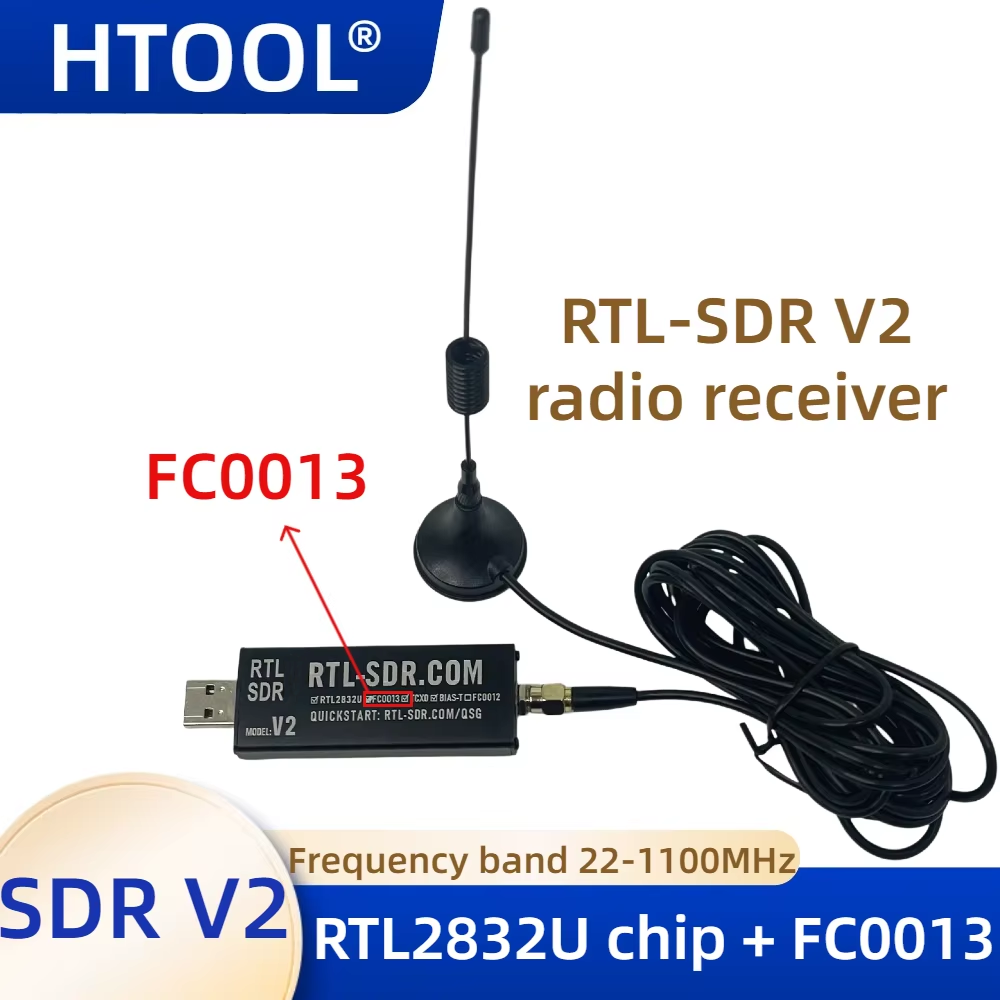
SDR Radio Receiver RTL2832U RTL-SDR Chip Receiver with FC0013 Tuner Band 22-1100MHz
Stock Available: 108 units
Color
Selected: SDR V2 FC0013Product details
SDR-V2 radio receiver is an RTL-SDR receiver based on RTL2832U chip, equipped with FC0013 Tuner, the frequency band is expanded to 22-1100MHz, and supports L-band input. Suction Cup Antenna: Length: 3 meters Connector: SMA male-to-male Pole Length: 175 mm Frequency: 698–1800 MHz Gain: 3 dBi 1. RTL-SDR V2 cannot receive shortwaves, because the RTL-SDR RTL2832U chip itself does not directly support shortwave reception, because it lacks the direct downconversion function for the HF band (below 24 MHz), so RTL-SDRV2 cannot receive shortwaves due to hardware limitations. If you want to receive shortwave, it is recommended to choose RTL-SDR V4 RTL-SDR has a rich supporting software ecosystem, covering multiple platforms such as computers, tablets, and mobile phones. Real-time sampling rate: Approx. 2.4 MS/s (million samples/sec) Actual stable value may be slightly lower) I/Q mode: Support complex sampling (orthogonal downconversion) Resolution: Number of ADC bits: 8-bit (RTL2832U built-in) with limited dynamic range for entry-level applications. Interface: USB 2.0: Depends on computer processing signals (may be limited by USB bandwidth) Cost-effective entry SDR: -Compared with professional SDR equipment (e.g. HackRF, USRP), it is inexpensive and suitable for beginners to learn radio technology. Compatible with mainstream SDR software (SDR#, GORX, HDSDR, CubicSDR, etc.) without additional drivers. Open source ecological support: Rich software support from the global developer community, such as: SDR# (windows platform, easy to use) -GORX (Linux/macOS, support for harmonic analysis) -rtl_433 (decoding 433MHz sensor signal) -dump1090 (Aeronautical ADS-B Signal Decryption) Low-power and portable design •USB power supply, no external power supply required Typical application scenarios: Amateur radio & spectrum monitoring monitoring of aviation bands (1090MHZADS-B), amateur radio stations (HFHF/UHF), FM/AM broadcasting, etc. Analyze the local radio environment and troubleshoot sources of interference.
Estimated delivery: Sun 18 Oct – Wed 21 Oct
Free shipping to the UK
Security & Privacy
Quantity
SDR-V2 radio receiver is an RTL-SDR receiver based on RTL2832U chip, equipped with FC0013 Tuner, the frequency band is expanded to 22-1100MHz, and supports L-band input. Suction Cup Antenna: Length: 3 meters Connector: SMA male-to-male Pole Length: 175 mm Frequency: 698–1800 MHz Gain: 3 dBi 1. RTL-SDR V2 cannot receive shortwaves, because the RTL-SDR RTL2832U chip itself does not directly support shortwave reception, because it lacks the direct downconversion function for the HF band (below 24 MHz), so RTL-SDRV2 cannot receive shortwaves due to hardware limitations. If you want to receive shortwave, it is recommended to choose RTL-SDR V4 RTL-SDR has a rich supporting software ecosystem, covering multiple platforms such as computers, tablets, and mobile phones. Real-time sampling rate: Approx. 2.4 MS/s (million samples/sec) Actual stable value may be slightly lower) I/Q mode: Support complex sampling (orthogonal downconversion) Resolution: Number of ADC bits: 8-bit (RTL2832U built-in) with limited dynamic range for entry-level applications. Interface: USB 2.0: Depends on computer processing signals (may be limited by USB bandwidth) Cost-effective entry SDR: -Compared with professional SDR equipment (e.g. HackRF, USRP), it is inexpensive and suitable for beginners to learn radio technology. Compatible with mainstream SDR software (SDR#, GORX, HDSDR, CubicSDR, etc.) without additional drivers. Open source ecological support: Rich software support from the global developer community, such as: SDR# (windows platform, easy to use) -GORX (Linux/macOS, support for harmonic analysis) -rtl_433 (decoding 433MHz sensor signal) -dump1090 (Aeronautical ADS-B Signal Decryption) Low-power and portable design •USB power supply, no external power supply required Typical application scenarios: Amateur radio & spectrum monitoring monitoring of aviation bands (1090MHZADS-B), amateur radio stations (HFHF/UHF), FM/AM broadcasting, etc. Analyze the local radio environment and troubleshoot sources of interference.